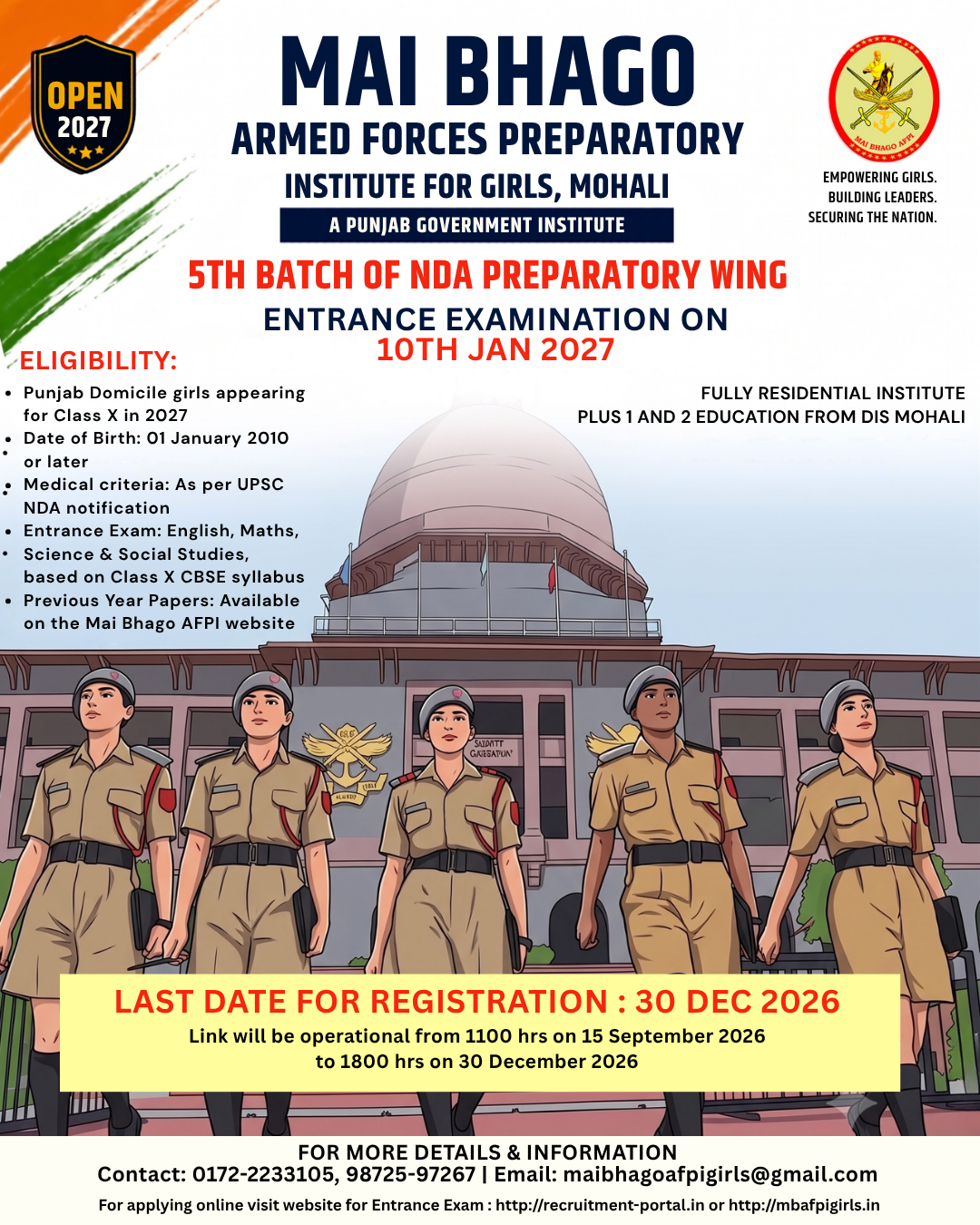

Punjab girls joining Indian Army success stories are no longer rare — and the data from Mai Bhago AFPI Mohali proves it. Out of 175 lady cadets who completed training at this Punjab Government residential institute, 105 have been recommended for commission into the Indian Armed Forces. That is a 60% commission rate at a time when the national average for NDA candidates hovers between 15% and 20%.
This guide examines what is behind that number. It presents the profiles of real cadets — their starting points, the obstacles they faced, and the specific training that transformed them into commissioned officers. It also explains why Punjab girls joining Indian Army success stories from Mai Bhago AFPI are structurally different from the outcomes produced by private NDA coaching centres.
Mai Bhago AFPI Mohali is a Punjab Government initiative named after the legendary Sikh warrior Mai Bhago Ji — a woman who led the Forty Immortals in battle at Khidrana. The institute trains Class 10 pass-out girls in a three-year residential program that covers academics, physical training, and SSB preparation simultaneously. Punjab girls joining Indian Army success stories from this institute carry a distinct credential: these women were built for service, not coached for an exam.
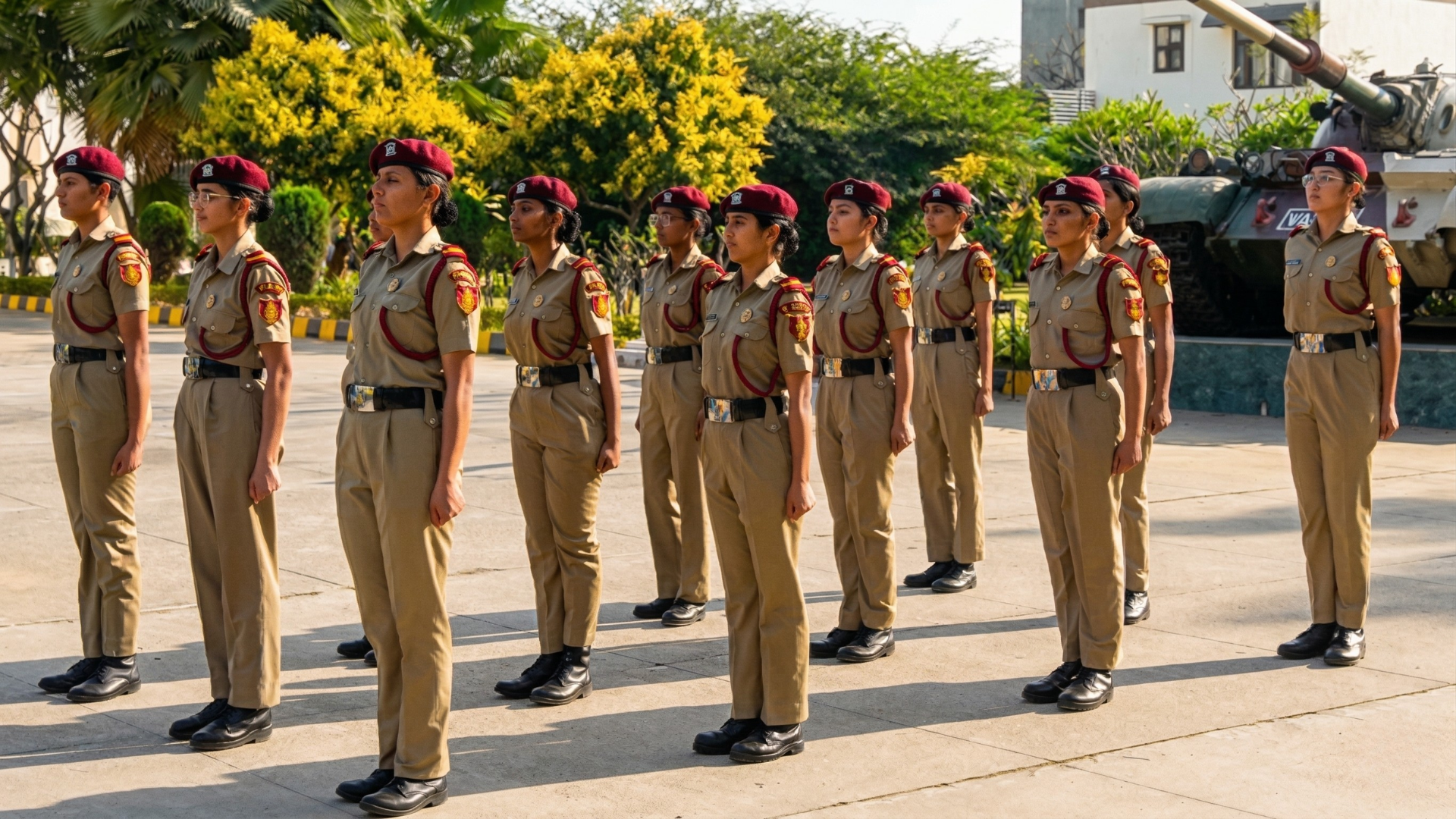
Why a 60% Commission Rate Is Extraordinary
The Punjab girls joining Indian Army success stories from Mai Bhago AFPI are grounded in a verifiable number. The UPSC NDA exam is cleared by a fraction of applicants — and even among those who clear it, only 25% to 30% pass the SSB interview. The national commission rate across all NDA-aspiring candidates is estimated at 15% to 20%. Mai Bhago AFPI’s 60% rate is not a statistical outlier; it is a systemic result.
To understand why, you need to understand what is actually being measured. The SSB interview does not test subject knowledge. It tests Officer-Like Qualities (OLQs) — traits like initiative, confidence, social intelligence, planning ability, and physical stamina. These cannot be developed in a six-month coaching cycle. They require years of structured exposure, daily feedback, and a high-performance peer environment.
Mai Bhago AFPI Mohali provides exactly that environment across three full years — starting from Class 10 onwards. By the time cadets appear for the SSB, they have already spent 1,000-plus days operating under conditions that mirror what assessors look for. That is the structural advantage behind every success story from this institute.
Profile 1 — From Ludhiana to the National Defence Academy
Punjab girls joining Indian Army success stories begin, in many cases, before the girl herself knows it is possible. In Ludhiana — Punjab’s industrial capital and its most densely populated city — a student from a middle-class family transferred out of her regular school after Class 10 and joined the NDA Preparatory Wing at Mai Bhago AFPI Mohali. Her parents were apprehensive: a residential campus 90 kilometres from home, no family precedent in the armed forces, and a three-year commitment before any exam had even been attempted.
Her first semester was the hardest. The 5:30 AM reveille, the daily 5-km run, and the academic schedule running parallel to board exam preparation tested every assumption she had about herself. By the end of the first year, the physical discomfort had largely normalised. What remained — and strengthened — was a quality her SSB assessors would later describe as “sustained mental alertness under pressure.”
She cleared NDA Written I in her first attempt. At the SSB, she performed strongly across the Group Testing Officer (GTO) tasks — specifically the Command Task and the outdoor obstacle exercises — because she had been practising variants of these challenges at the institute for over two years. She is now a cadet at the National Defence Academy, Khadakwasla. She was 18 when she was recommended. She will be commissioned at 21.
Profile 2 — A Patiala Girl’s Choice: Mai Bhago AFPI vs Private Coaching
The second profile illustrates a decision most Punjab families face: a residential government institute versus a well-marketed private NDA coaching centre in Chandigarh. A girl from Patiala — a city with deep Sikh military heritage — had the option of enrolling in a one-year NDA coaching programme at a reputable Chandigarh centre. The coaching fee was approximately Rs 1.5 lakh for the year. Her family chose Mai Bhago AFPI instead.
The key difference she describes is not academic coaching — both options provided subject preparation. The difference was the SSB. At Mai Bhago AFPI, she began SSB-specific preparation from the very first month of training. She participated in mock GTO tasks on the institute’s obstacle course, group discussions moderated by trained assessors, and Thematic Apperception Test (TAT) practice sessions with structured feedback. Private coaching centres she visited later offered one or two SSB mock sessions at the end of the programme, typically as an add-on.
Punjab girls joining Indian Army success stories like hers depend on this preparation depth. She cleared Stage 1 of the SSB on her first attempt, performed solidly through Stage 2, and was recommended at the Allahabad Services Selection Board. She is currently serving in the Army Signals Corps. Her choice — government residential institute over private coaching — was validated by the only metric that matters: commission.
Profile 3 — First-Generation Defence Aspirant from Rural Punjab
Among the most important Punjab girls joining Indian Army success stories are those from families with no prior connection to the armed forces. A candidate from a village in Sangrur district — a region better known for agriculture than military tradition — had never met an Indian Army officer, had no access to SSB-oriented coaching, and had parents who were uncertain whether the defence forces were an appropriate career path for a young woman.
What made her journey possible was the Punjab Government’s scholarship provision at Mai Bhago AFPI. As a student from the SC reserved category, her fees were substantially subsidised, removing the financial barrier that stops most rural aspirants from considering a three-year residential programme. She joined the institute at 15, the youngest cadet in her batch.
Three years later, she cleared the UPSC NDA Written examination and passed the SSB conducted at Bangalore. She was commissioned into the Army Education Corps. In her post-commission interview shared with the institute, she specifically credited the institute’s structured daily routine — the discipline enforced not by punishment but by peer expectation — as the factor that built the self-regulation her SSB assessors noted. Her commission is not just a personal milestone. For her district, it is a signal that the armed forces are now a real option for rural Punjab girls.
The Common Thread: What Every Successful Cadet Shares
Reviewing the profiles of cadets who have generated Punjab girls joining Indian Army success stories at Mai Bhago AFPI reveals three consistent characteristics — none of which are about academic brilliance. The first is physical readiness at the point of SSB. Every successful cadet arrived at her Services Selection Board with running benchmarks already cleared, upper body strength developed over months of progressive training, and GTO physical tasks completed multiple times under assessment conditions.
The second characteristic is psychological self-awareness. The TAT, WAT, SRT, and SDT tests at Stage 2 of the SSB are designed to reveal how a candidate thinks — her values, priorities, and stress responses. Candidates who have spent three years in structured self-reflection, received feedback on their responses, and progressively refined their personality presentations perform markedly better than those who prepare for these tests in the week before the interview.
The third characteristic is comfort with authority and collective environments. The institute’s residential model means cadets eat together, train together, succeed together, and manage interpersonal conflict together. SSB assessors specifically evaluate social adaptability, group cohesion skills, and the ability to lead without undermining peers. Three years of residential life at Mai Bhago AFPI builds these traits far more effectively than any curriculum designed for the purpose. For broader context on the expanding opportunities for women in the forces, the 2026 update on opportunities for women in the Indian Armed Forces outlines all current entry routes and their requirements.
What Institutional Training at Mai Bhago AFPI Delivers
The Punjab girls joining Indian Army success stories that emerge from Mai Bhago AFPI are built on a daily structure that most people outside the institute do not fully understand. The programme is not a coaching course with physical training added on top. It is a military-readiness programme with academic preparation embedded within it — structured around the rhythms and demands of the armed forces from Day 1.
Academically, cadets complete the PSEB Class 11 and 12 curriculum in the science stream — covering Physics, Chemistry, Mathematics, and Biology — under faculty who coordinate the syllabus with NDA exam requirements. This means the board examination and the NDA written preparation are not separate tracks. They are aligned. A cadet who scores well in her board does so using the same knowledge base that powers her NDA Maths and GAT performance.
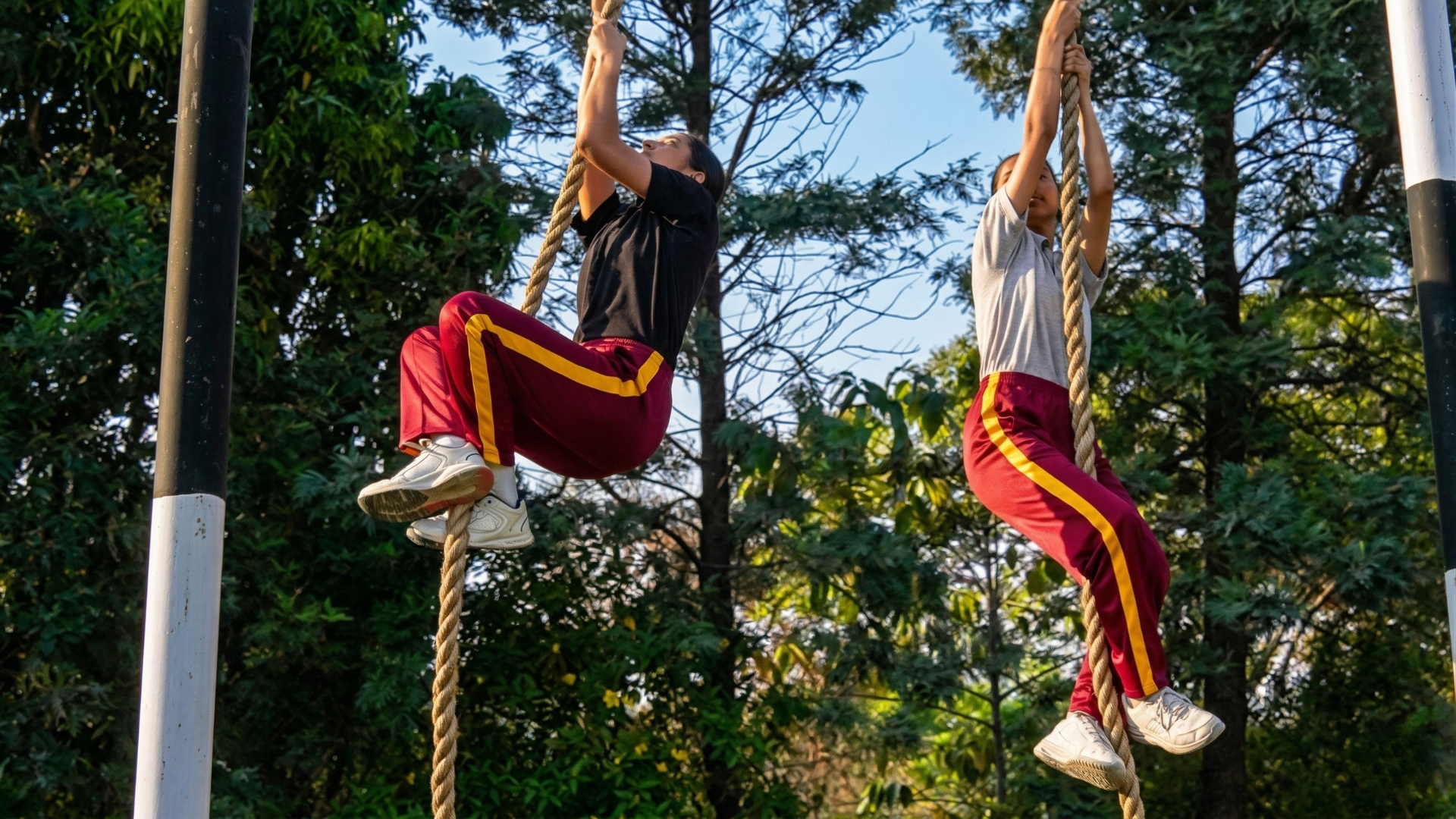
Physically, the programme operates a progressive training system across three years. Year 1 establishes foundations: cardiovascular endurance, upper body strength, coordination. Year 2 pushes intensity with timed obstacle courses, mock GTO tasks, and cross-training. Year 3 runs full-condition SSB simulations — realistic board environments with external assessors evaluating performance across all parameters. Cadets who go through this progression arrive at their actual SSB not as first-timers, but as practitioners. You can learn more about the expanding roles of women in the Indian Armed Forces as documented by PIB March 2026 to understand the career pathways these cadets are entering.
Why Self-Study and Coaching Cannot Replicate This
Private NDA coaching centres provide a service: exam-oriented academic preparation, test series, and sometimes a few SSB mock sessions. That is their offering, and within its scope they often do it well. But the outcomes data tells a clear story. A girl who spends 12 months in NDA coaching and then 12 months of self-preparation for the SSB arrives at her board with one practice framework. A girl who spent 36 months at Mai Bhago AFPI arrives with 1,000 days of applied readiness.
Punjab girls joining Indian Army success stories depend on this compound preparation. The SSB is not an exam where performance can be artificially elevated through technique alone. Assessors are trained military psychologists and officers. They distinguish between rehearsed responses and genuine personality. A cadet who has spent three years developing her actual confidence, leadership habits, and stress resilience under demanding conditions presents a fundamentally different profile from one who has rehearsed SSB answers.
For families comparing options, the data point that matters most is the commission rate. Mai Bhago AFPI Mohali: 60%. National NDA average: 15% to 20%. The gap is not marginal — it is structural. It reflects the difference between coaching for an exam and training for a career. To understand the role of discipline and quality benchmarks in military preparation, the blog on NDA preparation for girls in Punjab 2026 provides a comprehensive overview of what the journey from Class 10 to commission actually requires.
How to Join the Next Batch at Mai Bhago AFPI Mohali
Girls who have read the profiles above and recognise their own ambition in them should understand that the path to Punjab girls joining Indian Army success stories begins with a single application to the Mai Bhago AFPI Mohali entrance examination. The intake is for Class 10 pass-outs from Punjab. Both PSEB and CBSE board candidates are eligible. The entrance examination covers Mathematics, Science, English, and General Knowledge at the Class 10 level.
Selection involves three stages. Stage 1 is the written entrance examination. Stage 2 is a physical fitness assessment conducted at the campus in Mohali, Sector 80 — in the heart of the Tricity region accessible from Ludhiana (1 hour), Patiala (45 minutes), Jalandhar (1.5 hours), and Amritsar (2.5 hours). Stage 3 is a merit-based interview. Scholarship provisions exist for SC, BC, and OBC girls from Punjab, substantially reducing the financial commitment for eligible families.
The admissions process opens annually. Given limited seat availability relative to demand, applicants should monitor the official institute notification well in advance. For detailed information on the application timeline, fee structure, and entrance examination syllabus, the complete NDA for girls in Punjab 2026 guide covers every stage of the process. Families already researching longer-term career outcomes will find the breakdown of armed forces compensation and career progression helpful — a subject covered fully in a companion resource on women officer salary and career pathways. For understanding the SSB preparation structure that Mai Bhago AFPI builds through residential training, the detailed guide on how to crack SSB interview for girls in Punjab outlines the full five-day process and the specific qualities assessors evaluate.
The institute’s record speaks for itself. 105 commissioned officers from 175 cadets is not a marketing number — it is a verifiable outcome that parents can research and that alumni will confirm. For a girl in Punjab deciding where to invest three years of her life and what kind of officer she wants to become, that number is the place to start.
The reference table below summarises the key metrics, entry requirements, and outcome indicators that distinguish Mai Bhago AFPI’s training pathway from alternative preparation routes.
| Parameter | Mai Bhago AFPI Mohali | Private NDA Coaching | Self-Study |
|---|---|---|---|
| Commission Rate | 60% (105/175 cadets) | 15-20% national avg | Variable, typically lower |
| Duration of Preparation | 3 years (post-Class 10) | 1-2 years | 6-18 months typical |
| Physical Training | Daily structured PT + GTO simulation | None included | Self-managed |
| SSB Preparation | 3-year progressive personality development + mock SSBs | Theoretical + 1-2 mock sessions | Book-based only |
| Academic Board Exams | Structured Class 11-12 PSEB program | Not included | Self-managed |
| Government Backing | Punjab Government institute | Private business | None |
| Scholarship / Subsidies | Available for SC/BC/OBC girls | None | None |
| Entry Point | Post-Class 10 (age 14-15) | Post-Class 11/12 | Any stage |
Frequently Asked Questions
Punjab girls joining Indian Army success stories from this institute include first-generation defence aspirants with no family military background. The entrance examination selects on academic performance and potential, not lineage. Girls from farming families, urban middle-class households, and SC/BC/OBC reserved categories are all represented in the current alumna community. Having no family connection to the forces is not a disadvantage — the three-year training builds everything from scratch.
Even without an SSB recommendation, every girl who completes the Mai Bhago AFPI programme holds a PSEB Class 12 board qualification. This qualification applies to all further education and employment pathways. Many cadets who are not recommended in their first SSB appearance attempt again through alternative armed forces entry routes open to graduates. The AFPI’s academic and physical preparation also positions cadets well for CDS (Combined Defence Services), territorial army entry, and civilian careers in the police, paramilitary, or public sector. The commission is the goal — but the training delivers far more than a single outcome.
The difference is the preparation depth. Punjab girls joining Indian Army success stories from this institute share a common characteristic: they arrive at the SSB having spent three years building the Officer-Like Qualities (OLQs) that assessors evaluate. Confidence, social intelligence, physical stamina, and command presence are not developed through coaching — they are habits formed over years of structured residential training. Mai Bhago AFPI starts this development at age 14-15, giving cadets 1,000-plus days of applied preparation before they face the first assessment board question.
The primary track is the NDA preparatory wing, which leads to the UPSC NDA examination and SSB. However, the physical training, academic preparation, and personality development translate to multiple entry routes. Cadets are also eligible for the Short Service Commission (Non-Technical) entry, the JAG entry for law graduates, and various other entry routes available to Class 12 pass-outs. Punjab girls joining Indian Army success stories from the institute include officers now serving in Signals, Education Corps, Army Medical Corps, and combat support arms — reflecting the breadth of career pathways available.
Mai Bhago AFPI Mohali operates as a secured government residential campus in Sector 80, Mohali — within the Tricity area and well-connected by road to major Punjab cities. The campus operates under the Punjab Government’s administrative oversight. Female staff supervise all residential facilities. The daily routine is structured from reveille to lights-out, with no unmonitored external access. Parents report that the level of discipline and security is comparable to a military cantonment environment. Many families from Ludhiana, Patiala, and Jalandhar visit the campus before admission and leave reassured.
The entrance physical assessment is appropriate for a Class 10 pass-out — it is a baseline, not a final fitness standard. Punjab girls joining Indian Army success stories at this institute include many who were not fitness-trained before joining. The three-year programme builds physical capability progressively — beginning with foundations in Year 1, building intensity in Year 2, and moving to peak-condition SSB simulation in Year 3. Girls who are reasonably active and committed to physical development are eligible regardless of their pre-joining fitness level.
Yes. The Punjab Government provides scholarship provisions for SC, BC, and OBC category girls admitted to Mai Bhago AFPI. These subsidies significantly reduce the financial commitment for eligible families — in many cases bringing the effective cost below that of private NDA coaching in Chandigarh. Scholarship applications are processed at the time of admission through the standard PSEB/Punjab Government scholarship documentation process. Families from Sangrur, Bathinda, Moga, and other rural districts have accessed these provisions successfully. The institute does not want financial barriers to prevent qualified girls from getting access to this training.
Applications Are Now Open for Mai Bhago AFPI Mohali
If your daughter’s story belongs alongside the Punjab girls joining Indian Army success stories featured on this page, the next step is an application. Mai Bhago AFPI Mohali is a government-backed residential institute that gives Class 10 pass-out girls in Punjab a three-year programme purpose-built for military commission. Seats are limited and awarded on merit.