
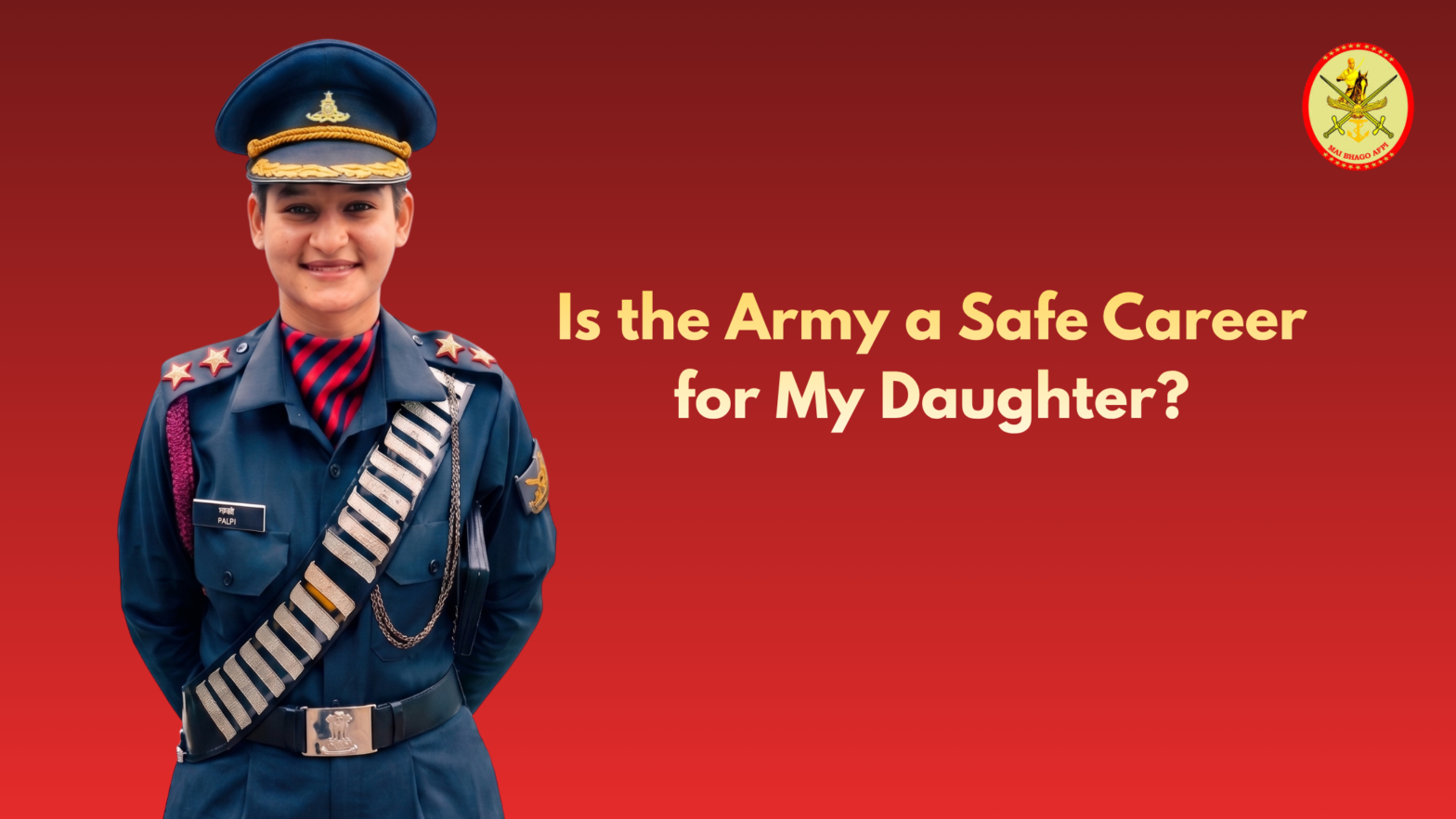
Is an army career safe for girls? Every year, a number of girls in Punjab clear the SSB and never join. Not because they failed anything, but because at home, someone said no.
The objection is almost never a flat refusal. It comes as a question: beta, uske baad shaadi kaise hogi? Posting kahan hogi? Kya wahan ladkiyaan safe hain? These are reasonable questions from parents who love their daughter and have very little accurate information to go on.
This piece is for those parents. It answers the nine questions parents actually raise, plainly, including the ones where the answer is uncomfortable. It is not here to sell anything or to tell you what to decide. The short version: an army career safe for girls is not the exception, it is the norm the data supports.

Myth 1: “It’s Not Safe for a Girl”
The reality: a woman officer lives on a military cantonment, in officers’ accommodation, inside one of the most tightly controlled residential environments in India. Movement is regulated, entry is controlled, and there is a chain of command personally accountable for her welfare.
Compare that honestly against the alternative most families accept without a second thought: a daughter renting a paying-guest room in Delhi, Bangalore or Gurgaon for a private-sector job, commuting alone at night, with no institutional accountability for her safety at all. If safety is the actual concern, the question of whether an army career is safe for girls has a clear answer. The cantonment is not the risky option.
Myth 2: “She’ll Never Get Married”
The reality: on the question of an army career safe for girls, this is the objection most often meant and least often said aloud, so take it seriously. Women officers marry, on roughly the same timeline as any other professional woman with a demanding career, and to serving officers and civilians alike. The armed forces have long-standing provisions for posting a serving couple to the same station, and a serving woman officer is, in most families’ honest assessment, a highly respected match.
There is one real constraint: cadets may not marry during training, at NDA, OTA, the Air Force Academy or the Naval Academy. A cadet who marries under training is discharged and must refund training costs. That is a rule about the training period, not the career. What a defence career genuinely changes is the shape of the decision: she will likely marry later, and marry someone who accepts that her posting has a say in where they live.
Myth 3: “She’ll Be Posted Somewhere Dangerous”
The reality behind the “army career safe for girls” worry about postings: the Indian Army has hundreds of establishments across the country, training institutions, depots, headquarters, records offices, workshops, hospitals, signal centres, ordnance and supply formations. Most officers, of any gender, spend most of their career in these. Women officers serve across Ordnance, EME, Signals, Engineers, Army Air Defence, Army Aviation, Intelligence, Education, the Judge Advocate General’s branch, the Army Service Corps and more. Direct combat infantry roles remain closed and under policy review.
Look at the two most recent Mai Bhago AFPI commissionings: Lieutenant Deepnoor into the Army Aviation Corps, Lieutenant Diksha Dhiman into the Army Ordnance Corps. Those are technical and logistics postings. A serving officer’s life carries risk. So does a life on Punjab’s highways. The question is not whether there is risk but whether it is proportionate, managed and backed by institutional support, and here it is.
Myth 4: “She Can’t Have a Family in the Army”
The reality: an army career safe for girls includes family life. Women officers have children, and the services provide maternity and child-care leave, family accommodation, service schools, and medical cover for the officer and her dependants for life.
The difficulty is real in the middle years: a young child, a posting change, a spouse in another city. Every working mother in India negotiates a version of this, but the Army version comes with subsidised housing, a school and a hospital on the station, and a community used to it.
Myth 5: “It’s a Man’s Environment, She’ll Be Harassed”
The reality, and no honest guide to an army career safe for girls can skip this one: it deserves a straight answer, not a reassuring one. Women have been commissioned as officers since 1992, three decades of institutional experience, not an experiment. The services have formal grievance mechanisms, a chain of command with accountability, and a disciplinary system that acts quickly.
Is any large institution free of bad behaviour? No, and any honest person will say so. What matters is whether there is a mechanism, whether it works, and whether the culture is moving. On all three counts the direction over thirty years has been steadily one way. The 2020 Supreme Court judgment on Permanent Commission for women officers, and the 2021 judgment opening NDA to women, were won, not gifted, and they changed the institution’s structure, not just its language.
Myth 6: “It’s Only a Ten-Year Job, Then What?”
The reality: this used to be the strongest objection to an army career safe for girls. It is now the weakest, and the one most parents have not updated. Following the Supreme Court’s 2020 judgment, Permanent Commission has been extended to women officers in eligible arms and services. A girl who enters through NDA today is on a permanent commission track from the start, on the same footing as her male batchmates.
Even a Short Service Commission is not a dead end. Fourteen years in the Flying Branch, or ten-plus-four in the Army, takes an officer into her mid-thirties with resettlement support, ex-servicemen benefits, and a service record that opens doors in aviation, logistics, corporate leadership, education and government service.
Myth 7: “The Training Will Be Too Hard for Her”
The reality: the training is hard. It is meant to be. And girls from Punjab are clearing it every year, which is the practical test of whether an army career safe for girls is achievable. The relevant question is not whether she can survive it but whether she has been prepared for it.
This is precisely the gap Mai Bhago AFPI exists to close: a residential institute where physical training, drill, academics and SSB preparation happen together over years, rather than crammed into a coaching module in the last six months. Read what a cadet’s day actually looks like in A Day in the Life of a Mai Bhago AFPI Cadet. It answers this better than any argument can.
Myth 8: “We’ll Never See Her”
The reality: in an army career safe for girls, distance is the real cost, not absence. Officers get annual leave, casual leave and travel concessions, and a cantonment posting is often easier for parents to visit than a shared flat in a metro. She will not be forty minutes away in Ludhiana, though; she will be wherever the Army needs her, from Assam to Ladakh, and most families find that harder in the first year than in the tenth.
Myth 9: “She Should Do a Government Job Instead”
The reality: an army career safe for girls is a government job, a Class-I Gazetted Officer post, with a pay-matrix level most state government recruits reach only after fifteen years, plus housing, lifelong medical cover, education concessions for children and a level of institutional respect very little else in India carries. If security, status and a pension-linked career is what you want for your daughter, you are already describing this. The entry routes are in our guide to NDA eligibility for women.
What Is Genuinely Hard About This Life
Any guide that lists only advantages is selling something. So, honestly:
- She will not choose where she lives. For a large part of her career, the Army does.
- She will move often, roughly every two to three years. That is disruptive for a spouse’s career and for children’s schooling.
- The first years are physically and mentally demanding, and she will be judged continuously.
- Some arms remain closed to women, notably combat infantry roles.
- Family emergencies at home are harder to reach from a distant station than from Chandigarh.
These are real costs. Weigh them, but weigh them against what they buy, and against what the alternative careers cost, which families rarely tally with the same rigour. When you do that honestly, the question of whether an army career is safe for girls usually answers itself.
Frequently Asked Questions
Women have served as officers in the Indian Army since 1992. Officers live in controlled cantonment environments with accommodation, medical facilities and a chain of command accountable for their welfare, plus formal grievance mechanisms. Measured against a young woman living alone for a private-sector job, an army career is safe for girls by comparison, not despite it.
Yes. Following the Supreme Court’s 2020 judgment, Permanent Commission has been extended to women officers in eligible arms and services. Officers entering through NDA are on a permanent commission track from the start.
Yes. On whether an army career safe for girls works day to day: marriage is not permitted during the training period at the academies, but is entirely permissible once commissioned.
A wide range, a fair proxy for how open an army career safe for girls actually is: Ordnance, EME, Signals, Engineers, Army Air Defence, Army Aviation, Intelligence, Education, the Judge Advocate General’s branch and the Army Service Corps. Direct combat infantry roles remain closed.
No. Mai Bhago AFPI’s recent commissionings include a professor’s daughter, a schoolteacher’s daughter, a businessman’s daughter and a farmer’s daughter. None from officer families. Family background is not a factor in whether an army career is safe for girls or open to them.
She will have spent her school or college years with structured academics, high physical fitness, English communication training and genuine discipline. Every one of those transfers to any other path. Very few preparation routes in India have that property.
Come and see for yourself
Mai Bhago AFPI is a Punjab Government residential institute in Sector 66, SAS Nagar (Mohali). Parents are welcome to visit the campus, see the accommodation, the mess and the training facilities, and speak to the staff before deciding anything. The best way to judge whether an army career is safe for girls is to walk the ground your daughter would train on.
Editorial note: policy on women’s entry, permanent commission and branch eligibility continues to evolve. Verify current provisions with official sources such as indianarmy.nic.in and joinindianarmy.nic.in before making decisions. This guide reflects the position as of September 2026.