
Becoming a woman fighter pilot in India was, until recently, a narrow side-door. In June 2016, Avani Chaturvedi, Bhawana Kanth and Mohana Singh became the first, commissioned into the fighter stream of the Indian Air Force through a scheme approved on a five-year experimental basis.
Ten years on, the experiment is over: it became a permanent scheme in 2022. On 13 June 2026, at the Combined Graduation Parade of the 217 Course at the Air Force Academy, Dundigal, Flying Officer Ishita Sangwan became one of the first women to reach the fighter stream through the National Defence Academy, a route that did not exist for girls until the Supreme Court opened NDA to women in 2021.
That matters most to a Class 11 girl in Punjab. The path to becoming a woman fighter pilot now starts straight out of Class 12, on a Permanent Commission, on the same terms as the boys in the exam hall next to you. Here is every route, and what each one costs.

The Three Routes, in One Place
There are three entries through which a woman can reach the Indian Air Force Flying Branch, and every path to becoming a woman fighter pilot runs through one of them:
1. NDA — after Class 12 with Physics and Mathematics. Permanent Commission.
2. AFCAT — after graduation. Short Service Commission of 14 years.
3. NCC Special Entry (Air Wing) — after graduation, with an NCC Air Wing Senior Division ‘C’ certificate. No written exam.
Everything below is detail on those three, plus the medical and aptitude gates that decide who actually flies.
1. Route 1: NDA, Straight After Class 12
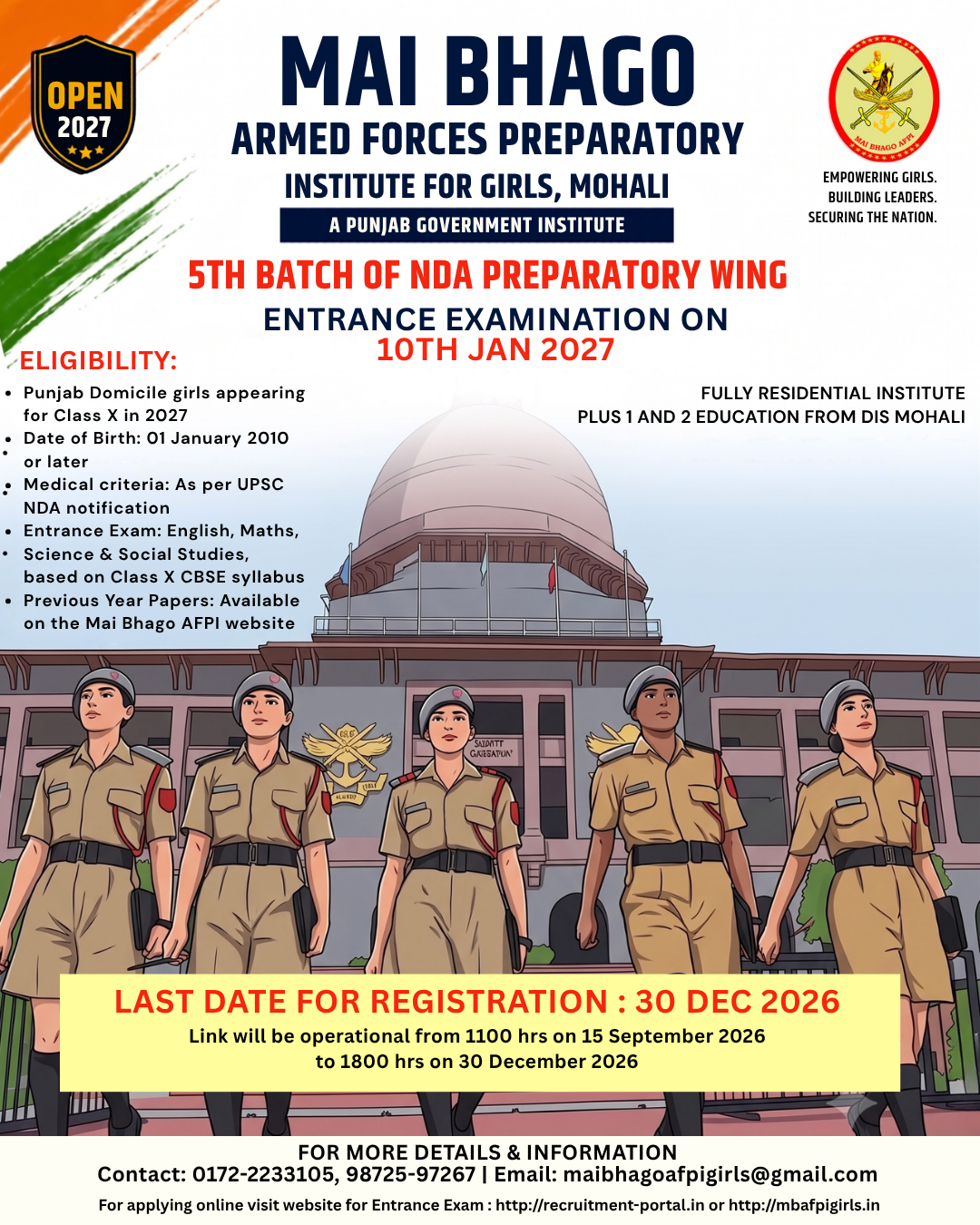
This is now the strongest route to becoming a woman fighter pilot, and the one Mai Bhago AFPI’s NDA Preparatory Wing exists to serve.
What you need: a Class 12 pass with Physics, Chemistry and Mathematics for the Air Force wing. Unmarried. The age band and date-of-birth window are specified in each UPSC notification, so read them exactly.
Why it is the strongest route: NDA gives a Permanent Commission, not a 14-year Short Service Commission, plus three years of joint-services training at Khadakwasla before the Air Force Academy, and it starts your career at roughly 21 instead of 24.
Female intake at NDA has expanded sharply since women were first allowed to sit the exam. Our full guide to NDA eligibility for women covers the age limits, application process and current vacancy position for a would-be woman fighter pilot.
The catch: you must clear both the written exam and the SSB, and you must be medically fit for flying duties at 17. There is no room to fix your eyesight later.
2. Route 2: AFCAT, After Graduation
If you finished school without PCM, or you have already passed the NDA age window, AFCAT is your entry to the Flying Branch.
What you need: a three-year degree with minimum 60%, plus at least 50% each in Mathematics and Physics at 10+2 level; or a BE/B.Tech with 60% and the same Class 12 condition. Age 20 to 24 at course commencement, relaxable to 26 if you hold a current DGCA Commercial Pilot Licence. Unmarried.
Note the trap: the 10+2 Physics and Mathematics requirement does not go away because you graduated in another subject. A girl who dropped Maths after Class 10 cannot enter the Flying Branch through AFCAT, whatever her degree. This is the single most common eligibility shock at this stage, and it is decided years earlier, in Class 11.
The commission through AFCAT is a Short Service Commission of 14 years in the Flying Branch, with no further extension. Full conditions are in our AFCAT eligibility guide for women.
3. Route 3: NCC Special Entry, Without a Written Exam
The least-known route to becoming a woman fighter pilot, and for the right candidate the cleanest.
If you hold an NCC Air Wing Senior Division ‘C’ certificate, you can apply for the Air Force Flying Branch through NCC Special Entry and be called directly for AFSB testing. The AFCAT written exam is waived.
What you need: the same degree and 10+2 Maths/Physics marks as the AFCAT route. The ‘C’ certificate must be within its validity period, two years from the date of issue against the advertisement date.
Vacancies are small, and so is the competition for them. If you are in Class 11 or your first year of college and an NCC Air Wing unit is available, joining it is one of the highest-return decisions on the path to becoming a woman fighter pilot.
4. The Medical Conditions That Decide Everything
More woman fighter pilot ambitions end at the medical board than at any exam. The Flying Branch standards are absolute:
- Vision: 6/6 uncorrected in both eyes. Spectacles and contact lenses are not permitted. There is no relaxation and no category exemption.
- Minimum height for women: 162.5 cm for the Flying Branch, against 152 cm for Ground Duty branches.
- Leg, thigh and sitting height are measured against cockpit limits, not general norms.
- Weight proportionate to height and age; standards on tattoos and past medical history applied strictly.
For parents of a Class 9 or 10 girl: if there is any early sign of refractive error, get it assessed now. Some conditions are manageable within medical-board limits, many are not, and the difference is worth knowing before a family builds a decade of expectation on a woman fighter pilot career.
And if the Flying Branch is medically closed, that closes flying, not a defence career. Ground Duty Technical, Administration, Logistics, the Navy, the Army and the Army Aviation Corps all remain open.
5. CPSS: The Test You Get One Attempt At
Every Flying Branch candidate recommended at the Air Force Selection Board must sit the Computerised Pilot Selection System (CPSS), formerly the PABT.
The Indian Air Force states the rule plainly: it is a once-in-a-lifetime test. Candidates who have failed CPSS or PABT before are permanently ineligible, and the bar extends to flying duties in the Army, Navy and Coast Guard.
This is why “apply for the Flying Branch and see how it goes” is bad advice for a would-be woman fighter pilot. You are spending an attempt you can never get back, so prepare the trainable parts of the test before you sit it.
6. Training: From Academy to Cockpit
Through NDA: three years at Khadakwasla ending in a degree, then flying training at the Air Force Academy, Dundigal, and commissioning as a Flying Officer at the Combined Graduation Parade. Through AFCAT or NCC Special Entry: direct to Dundigal for roughly 74 weeks of flying training.
Flying training is staged. Stage I is common basic flying. Suitability for the fighter stream is assessed during training, and those selected go on to Stage II fighter training on advanced jet trainers before converting to operational types. That is the last gate before a woman fighter pilot reaches an operational squadron.
7. How Fighter Streaming Is Actually Decided
This part is widely misunderstood. You do not apply to be a fighter pilot. You apply to the Flying Branch. Streaming into fighters, transport aircraft or helicopters happens during training at the Air Force Academy, based on your flying performance, your aptitude scores and the service’s operational requirement that year.
That is exactly how Flying Officer Ishita Sangwan reached the fighter stream through NDA in June 2026: she entered the Flying Branch and was streamed into fighters on performance.
The decision that makes someone a woman fighter pilot is taken by her flying instructors, not by a form. The preparation that matters is not “how do I get fighters” but “how do I fly well enough that they choose me”.
8. A Realistic Timeline from Class 11
| Stage | When | What to do |
|---|---|---|
| Class 11 | Now | Take Physics, Chemistry and Mathematics. This single choice keeps every route open. Get a full eye examination. |
| Class 11–12 | Two years | Prepare for NDA alongside boards. Build running and upper-body strength. Join NCC Air Wing if available. |
| Class 12 | Final year | Sit NDA. Apply for the Air Force wing. |
| If NDA converts | Age 17–21 | Three years at Khadakwasla, then Dundigal. |
| If NDA does not convert | Age 18–21 | Complete graduation with 60%+. Keep the fitness and Maths/Physics record intact. |
| Age 20–24 | Post-graduation | Sit AFCAT, or apply through NCC Special Entry if you hold the Air Wing ‘C’ certificate. |
The single highest-leverage decision on that table is taken at 15 or 16: choosing PCM in Class 11. Everything else can be recovered from. That cannot. If you want proof the route works, our profile of Komalpreet Kaur, AIR 18 follows one Mai Bhago AFPI cadet through the NDA exam.
Frequently Asked Questions
Permanently. The Ministry of Defence converted the experimental scheme for the induction of women fighter pilots into a permanent scheme in 2022.
Avani Chaturvedi, Bhawana Kanth and Mohana Singh, commissioned into the fighter stream in June 2016 through the Short Service Commission route.
No. Under CDS, women are eligible only for the Officers Training Academy, Chennai. The Air Force Academy entry through CDS is open to men. For a woman fighter pilot, the Flying Branch routes are NDA, AFCAT and NCC Special Entry.
Yes, and at 10+2 level specifically. Every Flying Branch route requires it, and a degree in another subject does not substitute for it.
162.5 cm for the Flying Branch. Ground Duty branches require 152 cm. Spectacles are not permitted; the Flying Branch requires 6/6 uncorrected vision in both eyes.
Punjab’s girls are already doing this
Mai Bhago AFPI in Mohali is a Punjab Government residential institute set up so that a daughter’s path to a commissioned officer’s career does not depend on what her family can afford in coaching fees. Its alumnae have been commissioned into the Air Force Academy, the Officers Training Academy and the Indian Naval Academy. If a woman fighter pilot’s cockpit is the goal, the NDA Preparatory Wing is where the route starts.
Editorial note: eligibility, medical standards and vacancy positions are laid down in official notifications and revised regularly. Verify against upsc.gov.in, afcat.cdac.in and careerairforce.gov.in before applying. This guide reflects the position as of September 2026.