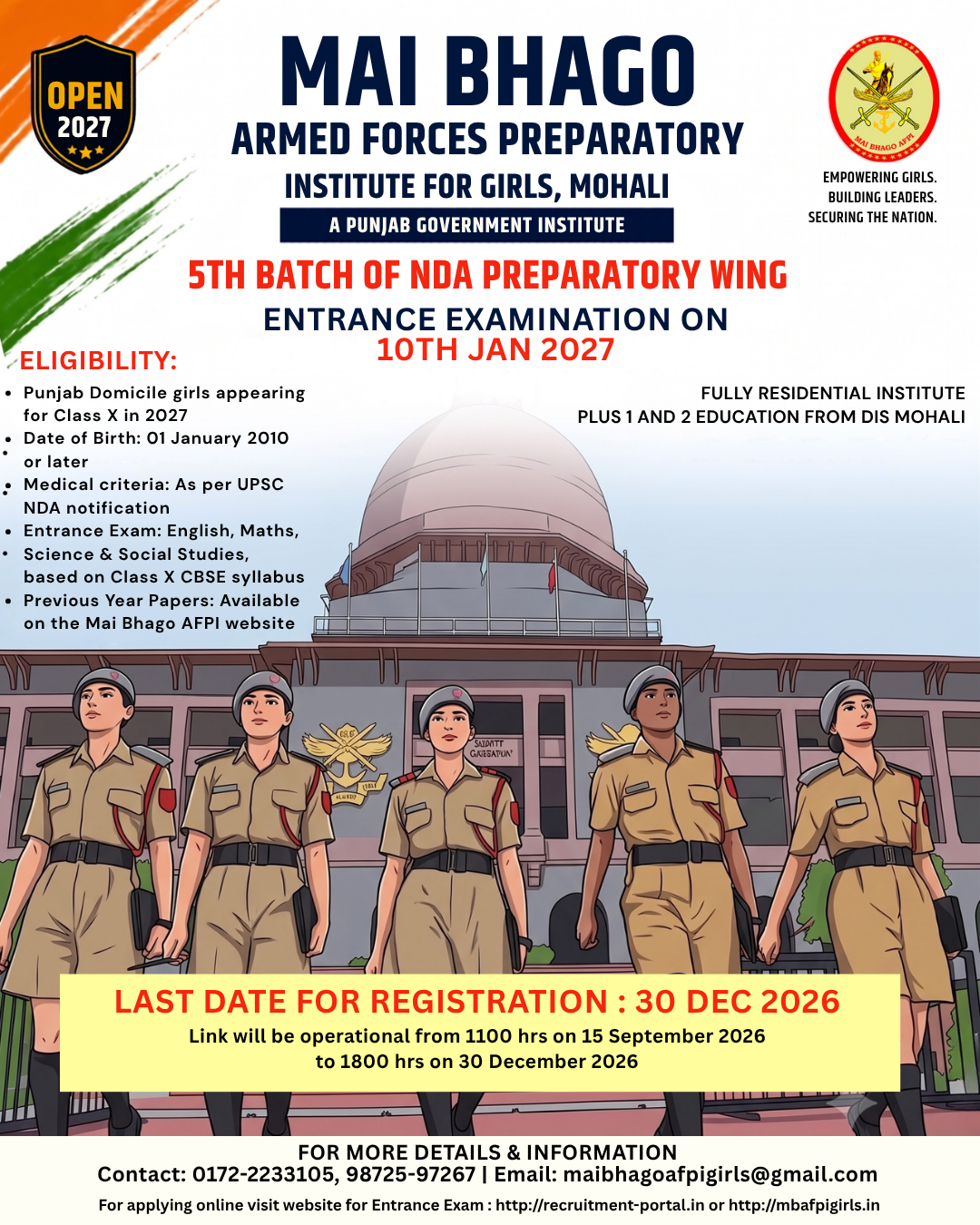

The physical fitness for NDA girls 2026 standard is one of the least understood aspects of NDA and SSB preparation — and one of the most decisive. Every year, female candidates who clear the UPSC NDA written examination fail at the SSB not because of weak academics or poor personality presentation, but because they are physically underprepared for the five-day Group Testing Officer tasks. The GTO physically eliminates candidates within the first 48 hours through the Group Obstacle Race, Individual Obstacles, and outdoor command tasks that demand genuine athletic conditioning.
This guide covers the exact physical fitness for NDA girls 2026 standards — the benchmarks for the SSB physical tests, the UPSC physical assessment at NDA entry, and the ongoing PT demands of NDA Khadakwasla itself — alongside the three-year progressive training model that Mai Bhago AFPI Mohali uses to build these standards from Class 10 onwards. The institute’s 60% commission rate — 105 of 175 lady cadets recommended — is built in large part on physical readiness that most candidates from private coaching backgrounds cannot match.
Mai Bhago AFPI Mohali is a Punjab Government residential institute where physical fitness for NDA girls 2026 is not a preparation module. It is the daily operating environment. From the 5:30 AM reveille to the evening PT session, physical conditioning is woven into the three-year programme at an intensity that mirrors what the SSB and NDA assess. Girls who complete this programme arrive at their SSB not as candidates who have “trained for the test” — they arrive as athletes who have been training for three years.
Why Physical Fitness Is a Decisive SSB Variable — Not Just a Qualifying Criterion
Most candidates approaching physical fitness for NDA girls 2026 treat it as a qualifying threshold — a checkbox to clear before the “real” SSB preparation begins. This is a fundamental misunderstanding of how the GTO tasks work. Physical fitness at the SSB is not a separate test with a pass/fail gate. It is a continuous variable that shapes every GTO interaction across all three days of Stage 2.
A candidate who enters the GTO physically fatigued — because she is unaccustomed to sustained outdoor exertion — loses cognitive confidence within hours. She cannot lead the Half Group Task because she is catching her breath.
She performs poorly on the Individual Obstacles because her upper body strength was never built. She withdraws from the Group Obstacle Race because the physical demands exceed what she trained for.
The GTO assesses Officer-Like Qualities — but OLQs like Initiative and Determination cannot be demonstrated by a candidate whose physical limitations are already dominating her attention.
This is why physical fitness for NDA girls 2026 is not a separate category from SSB preparation. Physical conditioning is the substrate on which all other OLQ development sits. A candidate with strong academics, a well-developed personality, and poor physical conditioning will consistently underperform in the GTO relative to a candidate of equal personality strength but superior fitness. Mai Bhago AFPI Mohali builds physical conditioning from Day 1 of the programme — not as an add-on, but as the structural foundation of the entire three-year preparation.
NDA Physical Fitness Standards for Women Cadets in 2026
The physical fitness for NDA girls 2026 benchmarks at the NDA itself (post-commissioning, during training at Khadakwasla) are distinct from SSB physical assessment requirements. Girls who are commissioned through the NDA as lady cadets must maintain these standards throughout the NDA training period. Understanding these standards at the beginning of preparation — rather than after commissioning — is what allows Mai Bhago AFPI cadets to arrive physically ready rather than physically surprised.
The NDA physical training for lady cadets includes the following assessed benchmarks in 2026:
- 1.6 km Run: Completion within 8 minutes 30 seconds (minimum qualifying time for lady NDA cadets)
- Sit-Ups: Minimum 25 repetitions in 2 minutes
- Push-Ups: Minimum 15 repetitions (full form)
- Obstacle Course: Completion within the qualifying time across a 10-obstacle course including rope climb, monkey bars, parallel barriers, and over-under structures
- Swimming: Basic swimming proficiency (25m minimum) — non-swimmers receive training at NDA
- Cross-Country Run: 4 km to 8 km timed cross-country runs conducted periodically throughout the training year
Cadets who arrive at NDA without having built these standards during their preparation period face an extremely difficult first term. The NDA does not wait for cadets to become fit — it trains at intensity from Week 1. The three-year Mai Bhago AFPI programme ensures that cadets arrive at NDA having already surpassed these benchmarks — not merely meeting them — so that the physical demands of the Academy represent a progression rather than a shock.
SSB GTO Physical Demands: What the Assessors Actually Measure
The SSB’s Group Testing Officer tasks are the specific physical assessment context for physical fitness for NDA girls 2026 preparation. Unlike a structured time trial, the GTO does not announce its physical demands in advance. The tasks are presented as leadership and teamwork challenges — but their completion requires cardiovascular endurance, upper body strength, and physical agility that can only be built through sustained training.
The five key GTO tasks and their physical demands are:
- Group Obstacle Race (GOR): A 10-obstacle team race. Requires cardiovascular fitness for sustained running between obstacles, upper body strength for rope climbs and over-under structures, and agility for quick transitions. Physically unfit candidates are unable to contribute to the group — and the GTO sees this as lack of teamwork and initiative, not just lack of fitness.
- Individual Obstacles (IO): 10 individual obstacles completed in sequence with increasing difficulty — each scored separately. Requires grip strength, upper body pulling power, core stability, agility, and fearlessness at height. Girls who have never practised obstacle work consistently fail obstacles 7 through 10.
- Half Group Task (HGT) and Full Group Task (FGT): Outdoor engineering problems solved as a team. Requires sustained physical activity — carrying logs, pulling ropes, climbing structures — while simultaneously exercising leadership. Candidates who are already physically depleted from the GOR cannot lead effectively here.
- Command Task: A specially designed task where the candidate is the commander. Physical confidence and spatial agility shape how clearly the commander communicates instructions and demonstrates the task to subordinates.
- Lecturette: While primarily verbal, physical presentation — posture, breath control, vocal projection — is affected by the candidate’s aerobic fitness and recovery capacity after the physically demanding sessions that precede it.
Year 1 at Mai Bhago AFPI: Building the Foundation
The Year 1 approach to physical fitness for NDA girls 2026 at Mai Bhago AFPI Mohali deliberately starts at a level accessible to Class 10 pass-outs with no prior athletic training. The first year is not designed to build peak SSB-ready fitness. It is designed to establish physiological foundations — aerobic base, musculoskeletal conditioning, body awareness, and the fundamental discipline of a structured daily PT routine.
Year 1 daily PT elements include a 3 to 5 km morning run at a conversational pace, progressing to a 5 km timed run by Month 6. Basic calisthenics — push-ups, sit-ups, squats, lunges, burpees — are introduced in cycles of 3 sets moving to 5 sets across the year. Obstacle course familiarisation sessions are conducted weekly, focusing on technique rather than speed: rope grip, balance beam positioning, bar traversal form, and landing mechanics. Flexibility and mobility work — stretching, yoga-based routines — is integrated into the evening session three times per week to prevent injury as intensity builds.
The critical outcome of Year 1 is not a specific fitness benchmark. It is the conditioning of the daily PT habit — the physical and psychological normalisation of the early-morning run, the group workout, and the discipline of showing up to an outdoor training session regardless of temperature, season, or fatigue.
Punjab’s winters in Mohali are cold enough to make 5:30 AM runs genuinely demanding. Girls who train through this for a full year arrive at Year 2 with a level of physical mental resilience that girls who start training six months before their SSB simply cannot replicate.
Year 2 at Mai Bhago AFPI: Pushing Intensity
Year 2 is where physical fitness for NDA girls 2026 preparation at Mai Bhago AFPI shifts from foundation-building to performance development. The cardiovascular programme extends the daily run to 6 to 8 km, introduces interval training (400m repeats, hill runs), and adds a weekly timed 1.6 km run to track against the NDA qualifying benchmark. The target by the end of Year 2 is consistent 1.6 km completion under 8 minutes — leaving margin above the 8:30 minimum qualifying time.
The obstacle course programme in Year 2 moves from technique to speed. Cadets complete the full 10-obstacle course under timed conditions, with each obstacle assessed individually for both form and completion speed. Upper body strength training intensifies: dead hangs, negative pull-ups, assisted pull-ups, and eventually full pull-ups are introduced as the Year 2 programme progresses. By the end of Year 2, most cadets can complete the obstacle course at a pace and confidence level that places them above the threshold the GTO physically screen for.
Group physical challenges are introduced in Year 2 as a complement to individual fitness. Teams race through modified GTO-style obstacle courses — not to simulate the SSB exactly, but to build the experience of physical exertion under group pressure. A cadet who has run 8 km and then completed a team obstacle race knows how her body feels under physical stress. When the SSB’s GOR places her in that state again, it is not unfamiliar. She can lead from that state because she has done it before.
Year 3 at Mai Bhago AFPI: Full SSB Simulation Conditioning
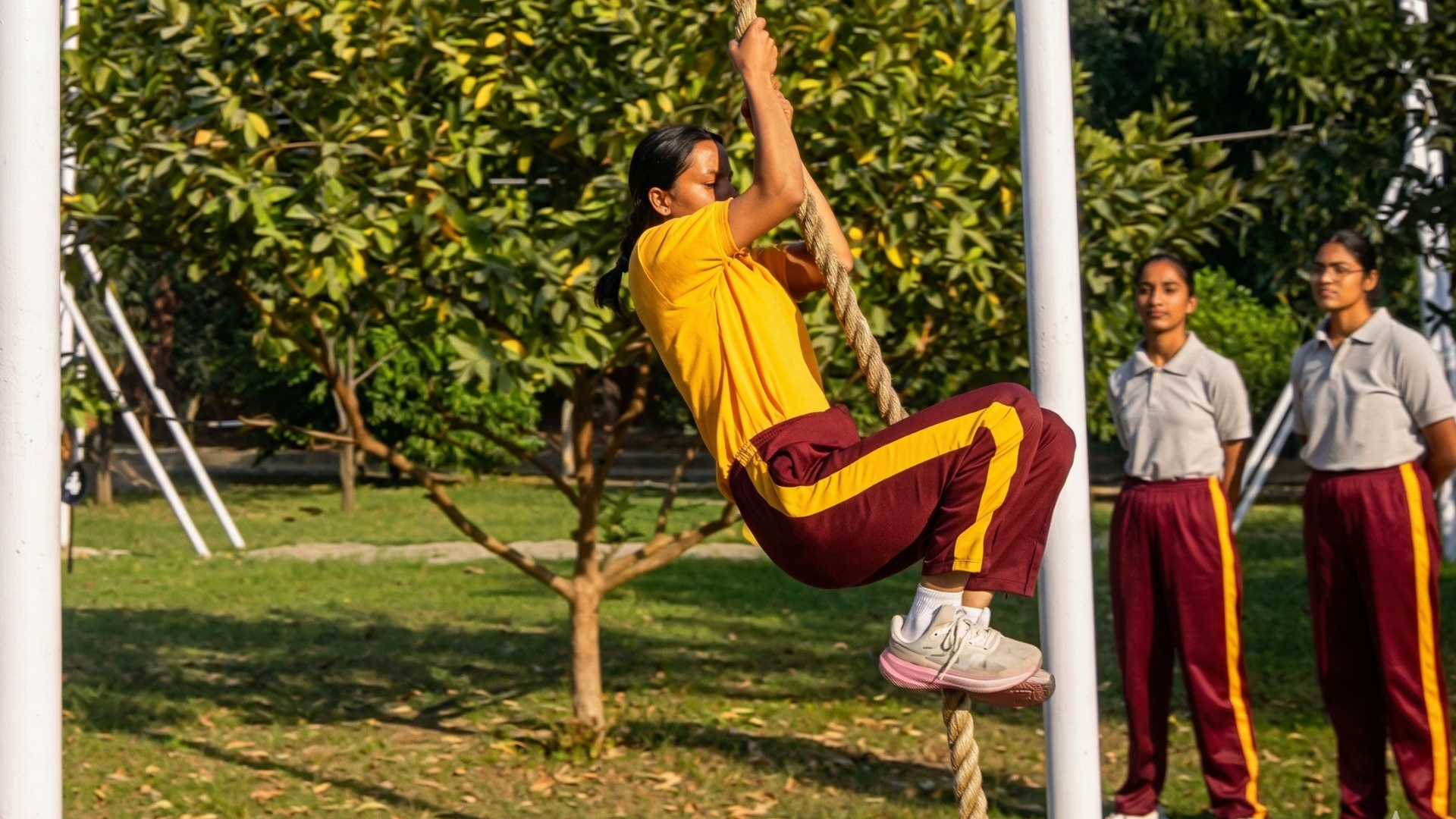
Year 3 physical training at Mai Bhago AFPI is calibrated specifically to the SSB standard for physical fitness for NDA girls 2026. The daily run extends to 8 to 10 km with regular timed 1.6 km intervals targeting sub-7:30 completion — well inside the NDA qualifying threshold. Upper body conditioning reaches full GTO obstacle competency: most cadets can complete the Individual Obstacles sequence within the expected time window for Stage 2 performance.
The defining feature of Year 3 is the full SSB physical simulation. The institute conducts mock SSBs in which cadets rotate through simulated GOR, HGT, FGT, and IO sequences over multi-day sessions — mirroring the compressed, consecutive physical demand of the actual five-day SSB. Assessors — including external assessors in some sessions — evaluate physical confidence, leadership from a position of physical exertion, and recovery behaviour between tasks. Cadets who perform poorly in mock simulations receive targeted remediation before their actual SSB date.
One of the most valuable Year 3 conditioning outcomes is what can be called “physical leadership confidence” — the ability to be the first person to attempt an obstacle or direct a group through a physical challenge, rather than waiting for a peer to go first.
This specific trait — visible initiative under physical pressure — is one of the OLQs most clearly observable to GTO assessors and most difficult to fake. It is built only through repeated practice at genuine physical intensity, which is exactly what the three-year programme at Mai Bhago AFPI delivers.
For the full picture of how physical readiness connects to SSB commission outcomes, the SSB interview preparation guide for girls in Punjab documents all five GTO tasks and their specific evaluation criteria.
A Day in the Life: The PT Routine at Mai Bhago AFPI Mohali
Understanding physical fitness for NDA girls 2026 in the institutional context requires understanding how the daily schedule at Mai Bhago AFPI is structured. Physical training is not a scheduled period — it is the frame around which the entire day is built. The following represents a standard weekday PT structure in Year 2 or Year 3 of the programme.
- 05:30 — Reveille: Wake-up and room inspection. No snooze culture. The discipline of an immediate physical start is itself a psychological conditioning tool that mirrors barrack life and SSB assessment centre schedules.
- 05:45 to 07:15 — Morning PT: 6 to 8 km run (Year 2) or 8 to 10 km run (Year 3) with timed 1.6 km intervals periodically integrated. On alternate days, calisthenics circuits replace the long run. On obstacle training days, the morning session includes the timed obstacle course.
- 07:15 to 08:00 — Personal Time: Bath, breakfast, uniform preparation. The speed of this transition — from intense physical exertion to organised daily functioning — is itself a conditioning element. SSB assessment centres run on the same compressed schedule.
- 08:00 to 13:30 — Academic Sessions: PSEB Class 11/12 syllabus combined with NDA written paper preparation. Physical training is paused for the academic blocks.
- 13:30 to 14:30 — Lunch and Rest: Structured rest period — not optional recreation. Physical recovery is treated as a training element.
- 14:30 to 16:30 — Afternoon Sessions: Rotating between sports practice (basketball, volleyball, kho-kho, swimming depending on facility access), SSB psychological test practice, and group discussion sessions.
- 16:30 to 18:00 — Evening PT: Flexibility, mobility, yoga, or sport-specific conditioning. Lower intensity than the morning session but consistently scheduled.
- 18:00 to 20:30 — Study Hall and Dinner
- 21:30 — Lights Out
The total structured physical activity across this daily schedule — morning PT plus afternoon sport plus evening conditioning — is 3 to 4 hours per day. Across three years, this amounts to approximately 3,000 to 4,000 hours of structured physical activity before the SSB.
No private coaching programme, no self-study schedule, and no last-minute preparation can replicate this volume. This is the structural explanation for why physical fitness for NDA girls 2026 produced at institutional training level is categorically different from that produced by self-study.
Understanding the complete NDA preparation journey — academic, physical, and psychological — is covered in the NDA for girls in Punjab 2026 guide.
30-Day Self-Training Schedule for Girls Preparing Independently
For girls who are preparing for the SSB outside of an institutional programme, the following 30-day schedule provides a structured approach to building the specific physical fitness for NDA girls 2026 standard that the GTO demands. This schedule should be treated as a minimum viable preparation — not as a substitute for the institutional training model.
| Week | Running Target | Strength Target | Obstacle / Agility |
|---|---|---|---|
| Week 1 | 3 km daily, easy pace; timed 1.6 km on Day 5 | 3 sets 15 push-ups, 20 sit-ups, 20 squats daily | Bar hang: 30 sec holds x 5; identify local obstacle or playground equipment for Week 2 |
| Week 2 | 5 km daily; 400m x 6 intervals on Day 4; timed 1.6 km on Day 7 | 4 sets 20 push-ups, 25 sit-ups; add dead hangs 45 sec x 5 | Climb / traverse available equipment; practice over-under movements; timed completion |
| Week 3 | 6 km daily; hill runs or stairs on Day 3; timed 1.6 km on Day 6 | 5 sets progressive push-ups and pull-up negatives; core circuit 15 mins daily | Full obstacle simulation if available; practice climbing, jumping, and balance sequences under time pressure |
| Week 4 | 8 km long run on Day 1; taper to 4 km on Days 5-7; final timed 1.6 km on Day 7 | Max-effort strength test: push-ups in 2 mins, sit-ups in 2 mins; compare to NDA benchmarks | Full sequence obstacle run x 2; SSB-style GOR simulation with 2-3 peers if possible |
Nutrition and Recovery: What the Programme Includes
An often-overlooked dimension of physical fitness for NDA girls 2026 is the nutritional support that institutional training programmes provide. At Mai Bhago AFPI Mohali, the mess provides three structured meals per day calibrated to the physical demands of the training programme. Protein-adequate vegetarian and non-vegetarian options are available. Breakfast is timed to follow the morning PT session, allowing the post-exercise window to be used for recovery nutrition.
For girls preparing independently at home, nutrition is often the most neglected training variable. A girl running 6 km per morning and completing calisthenics daily has meaningfully higher protein and carbohydrate requirements than a student who does not train. Families of girls preparing for the NDA physical standard should ensure that the daily diet includes adequate protein (eggs, dal, paneer, curd), complex carbohydrates (roti, rice, oats), and iron-rich foods — particularly important for girls whose menstrual cycle can affect endurance performance if iron stores are depleted.
Recovery sleep — 8 hours minimum — is non-negotiable for physical adaptation. The body builds strength and endurance during recovery, not during training sessions.
Mai Bhago AFPI’s lights-out at 21:30 and 05:30 reveille provides a consistent 8-hour sleep window that the structured programme enforces as a training element in its own right. Girls preparing independently should treat sleep as a part of their physical training programme, not a variable to be sacrificed for extra study time.
For how physical readiness connects to the full success outcome of commissioned officers from Punjab, the Punjab girls joining Indian Army success stories documents what the combination of physical, academic, and psychological preparation produces.
Frequently Asked Questions
The current physical fitness for NDA girls 2026 benchmark for the 1.6 km run at the NDA training level is 8 minutes 30 seconds as the minimum qualifying time for lady cadets. However, the SSB itself does not have a published time-trial running test — instead, physical fitness is revealed through the GTO task performance across the five-day evaluation. Candidates who can complete 1.6 km in under 8 minutes, and sustain 6 to 8 km of activity, consistently perform better across all GTO tasks. Mai Bhago AFPI trains cadets to a 7:30 target for 1.6 km — well inside the qualifying threshold — to ensure performance margin at the actual assessment.
Six months of consistent, structured training can produce meaningful improvements in cardiovascular fitness and basic strength — but it is generally insufficient to build the specific physical fitness for NDA girls 2026 depth that the SSB’s GTO tasks reward. The GTO obstacle tasks require grip strength, upper body pulling strength, and agility that develop slowly over months of progressive training. A girl who begins training six months before the SSB will likely clear the GOR and basic obstacles but may struggle with higher-difficulty Individual Obstacles and the physical recovery demands of Day 3. Three years of training at Mai Bhago AFPI produces a physically prepared candidate. Six months produces a relatively conditioned one — and the GTO sees the difference.
Yes — and this is one of the underappreciated conditioning advantages of the three-year residential programme. Punjab winters in Mohali see temperatures drop to 5 to 8 degrees Celsius in December and January. Morning PT sessions continue through winter at 5:30 AM, training cadets to perform physically under cold-weather conditions that SSB assessment centres — many of which are in hill stations or cold-weather postings — also operate in. A cadet who has trained through Mohali winters for three years finds cold-morning GTO sessions significantly less intimidating than a candidate from an urban coaching background who has trained only in comfortable conditions.
Swimming is a part of physical fitness for NDA girls 2026 preparation within the NDA campus itself — lady cadets are expected to achieve basic swimming proficiency during their NDA training years. Non-swimmers receive coaching at the NDA, so non-swimming candidates are not disqualified at entry. However, those who arrive at NDA already able to swim at a basic level (25m minimum) face a significantly lower adjustment burden in the first term. Mai Bhago AFPI Mohali’s programme includes swimming access where campus facilities permit, giving cadets a head start on this aspect of NDA training.
The institute’s physical training programme is designed around progressive overload with injury prevention as an explicit goal. PTIs monitor load progression and individual recovery capacity. The campus has medical staff, and the programme includes mandatory rest and recovery periods that prevent overtraining injuries. In the event of an injury, the academic programme continues while the physical training is modified to exclude the affected area. Most minor injuries — muscle strains, plantar issues, minor joint inflammation — are managed within the campus medical facility. Serious injuries requiring specialist care are referred to Mohali district hospitals. No physical fitness programme that trains at meaningful intensity is entirely injury-free, but the institute’s structured progressive approach reduces the risk significantly versus self-training without supervision.
Sports constitute a significant portion of the afternoon physical engagement at Mai Bhago AFPI and serve a distinct purpose from the structured PT programme. Where PT builds baseline cardiovascular fitness, strength, and obstacle competency, sports develop agility, spatial awareness, competitive decision-making, and team dynamics — all of which are OLQ-relevant. Individual and team sports at the institute include basketball, volleyball, kho-kho, relay racing, and badminton. The institute participates in inter-institute sports competitions, giving cadets experience of structured competition under pressure — a further dimension of physical fitness for NDA girls 2026 preparation that private coaching cannot replicate.
The physical assessment at the time of Mai Bhago AFPI admission is appropriate for a standard Class 10 pass-out — it evaluates baseline fitness, not advanced athletic conditioning. No specialist sports training or athletic background is required. Girls who can run 1.5 km without stopping, complete 10 push-ups and 20 sit-ups, and demonstrate basic coordination are within the starting range expected by the programme. The three-year curriculum builds physical fitness for NDA girls 2026 from that baseline to SSB-ready standard across the full programme duration. Families should focus less on whether their daughter is currently fit enough, and more on whether she has the commitment to train consistently for three years — because that commitment, not current fitness level, is the primary admission consideration.
Build 3 Years of Physical Readiness — Not 3 Months
For physical fitness for NDA girls 2026 preparation that actually reaches the SSB standard, three years of institutional training is the proven model. Mai Bhago AFPI Mohali — a Punjab Government residential institute — builds physical readiness from a Class 10 baseline to full GTO-ready conditioning across its programme. 105 of 175 cadets have been commissioned. Applications open annually for Class 10 pass-outs from Punjab. Scholarships available for SC, BC, and OBC students.