
Most candidates prepare for SSB personal interview questions by memorising answers to things they found on the internet. The Interviewing Officer is not working from the internet. He is working from a two-page form you filled in on your first day at the board, and almost every question he asks will come out of it.
That form is the Personal Information Questionnaire, the PIQ, and it is the single most under-prepared document in the entire selection process. Candidates fill it in twenty minutes, tired, straight after screening, and then spend forty minutes in an interview built entirely from what they wrote. Here is how to get it right.

1. What the PIQ Actually Is
Almost every one of the SSB personal interview questions you will face traces back to the PIQ. The Personal Information Questionnaire is a structured form issued to candidates who clear Stage 1 screening. It captures your personal, family, educational, extra-curricular and employment details, and it is the working document for the Interviewing Officer, the third of the three independent assessors at the board alongside the Psychologist and the GTO.
It is also seen, in part, by the other assessors, so it is not a formality you hand in and forget. It is the version of yourself the board will spend five days testing against your actual behaviour. The central principle follows: whatever you write, you will be asked to demonstrate.
2. Every Section of the PIQ, and What It Invites
Each row of the form is a hook for a set of SSB personal interview questions. Personal details, name, age, height, weight, place of birth, present and permanent residence, district and state. Invites questions about your district, its crops, industries, rivers, history, MP and MLA, and current issues. A girl from Gurdaspur who cannot name her district’s major crops or its border situation has a difficult opening five minutes.
Family details, parents’ occupations, income bracket, siblings and their education. Invites questions about your father’s work in real detail, your family’s finances, and who influences you.
Educational record, every school, board, percentage, medium of instruction, and any gaps or repeats. Invites an explanation for every dip and gap year. Do not hide them; they are in your marksheets.
Positions of responsibility, monitor, house captain, NCC rank, sports captaincy, club office. Invites “tell me about a time you had to make an unpopular decision.” This is the richest section for evidencing Officer Like Qualities, and most candidates leave it half-empty.
Extra-curricular activities, sports and hobbies, games and the level played, hobbies, NCC camps, NSS work. This invites the sharpest questioning at the board, and where most caught exaggerations happen.
Preferences, your service and entry preferences, and previous SSB attempts with dates, boards and results. Invites “you were conferenced out last year, what have you changed since?” You must have a real answer.
3. The Four Rules of Filling a PIQ
Get these four right and most SSB personal interview questions become answerable. Rule 1: write only what you can defend for ten minutes. If your hobby is reading, name the last three books and be ready to discuss them. If it is gardening, name what you grow and when you sow it. “Listening to music” invites “name three ragas, who composed that, what instrument”. Vague hobbies are not safe hobbies, they are unprepared hobbies.
Rule 2: never inflate. District-level when you played inter-school, state-level when you played district, board rank when you had a school rank. Assessors have done this for years and the follow-ups are specific: which venue, which month, who else played, what was the score. A single exposed exaggeration reframes your entire candidature as untrustworthy, and honesty is an assessed quality.
Rule 3: fill every section. Blank rows read as an empty life. With no formal position of responsibility, write the informal ones: organised the farewell, ran exam coordination for the class, taught younger siblings, ran the household during your mother’s illness. These count as leadership data.
Rule 4: be consistent across all three assessors. Your PIQ, your psychology test responses and your GTO behaviour are compared at the conference. A candidate who writes “captain of the volleyball team” and then contributes nothing in the Group Discussion has created a contradiction the board will resolve against her.
4. What the Personal Interview Is Really Assessing
The interview is not a knowledge test. It is a structured assessment of the fifteen Officer Like Qualities, grouped broadly into planning and organising ability, social adjustment, social effectiveness and dynamic qualities such as determination, courage and stamina.
The Interviewing Officer samples these through your life history, because past behaviour is better evidence than a rehearsed answer. That is why the SSB personal interview questions are about your district, your father’s work, your Class 11 marks, your friends and your failures, not about defence policy. Our five-day SSB breakdown sets the interview in context.
5. The Questions Genuinely Asked, by Category
These are the SSB personal interview questions that come up again and again, sorted by where they originate on the PIQ. About your family: describe your father’s work in detail. What is the family’s monthly income? Who is closest to you at home, and why? What do your parents think of your joining the armed forces, and who disagrees?
About your education: why did your percentage drop between Class 10 and Class 12? What was your medium of instruction? What did you do in your gap year? Name three teachers who influenced you.
About your locality: which district are you from and what is it known for, what are the main crops, what is the biggest problem facing your area, who is your MLA, and what is the population of your city.
About yourself: your three strengths and three weaknesses, who told you these, what you have done about the weaknesses, the biggest failure of your life and what changed after it, and what your friends would say if you were not in the room.
About your motivation: why the armed forces, why this entry, what your plan is if you are not selected, whether you would take a civilian job at three times the salary, and who in your family opposes this.
Situational: your team disagrees with your plan and time is short, what do you do? A close friend is cheating in an exam, what do you do? Little of this requires studying and much of it requires having lived and reflected. That is the design.
6. The Rapid-Fire Block
Some SSB personal interview questions come in a rapid-fire sequence, a burst of short questions with almost no gap between them. Candidates read this as hostility. It is not. It is a measure of speed of decision, composure and consistency under load.
Three rules survive it. Answer briefly and move on; do not elaborate unless asked. If you do not know, say so once, plainly, and stop, because “I don’t know, sir” is an acceptable answer and a confident fabrication is not. And do not change an earlier answer just because the pace increased, because consistency is being measured.
7. Mistakes That Cost Candidates the Interview
These are the errors that turn answerable SSB personal interview questions into a lost recommendation. Our wider guide to the common mistakes NDA and CDS aspirants make covers the habits behind them.
- Rehearsed answers delivered word-for-word. They are audible, and they signal that you are performing rather than thinking.
- A weakness that is a disguised strength. “I work too hard” is a wasted question. Give a real one, and what you are doing about it.
- Blaming others for a poor result, a failed attempt or a family circumstance. Ownership is directly assessed.
- Not knowing your own PIQ. Read your copy before the interview. Candidates genuinely forget what they wrote at 9 a.m. on Day 1.
- Weak English used as an excuse to say less. Fluency is not assessed; clarity and content are. Short, correct, confident sentences beat elaborate hesitant ones. This is a common issue for Punjabi-medium students and it is fixable.
- No answer to “what if you are not selected”. Every serious candidate should have one, and it should not be “I will keep trying forever”.
8. A Four-Week Preparation Plan
Four weeks is enough to prepare for SSB personal interview questions properly, if the weeks are used like this. Week 1, draft your PIQ at home. Get a blank format, fill it honestly, then interrogate every line. For each entry, write the three questions it invites and answer them out loud.
Week 2, build your own file. Your district: crops, industries, rivers, history, MP, MLA, current issues. Your father’s work, day to day. Your school and college: names, years, percentages, why each dip happened.
Week 3, live your PIQ. Play the sport you wrote. Do the hobby you wrote and be able to describe last week’s session. If you have no position of responsibility, take one now. Real activity gives you real material for the SSB personal interview questions on this section.
Week 4, mock interviews. With someone who will interrupt you, ask follow-ups and challenge inconsistencies. Record yourself, watch it once, fix the two worst habits, and stop watching. If you are also headed to an Air Force board, pair this with our guide to the AFSB and PABT/CPSS test.
Frequently Asked Questions
The Personal Information Questionnaire, a form capturing your personal, family, educational and extra-curricular details, issued after Stage 1 screening. It is the primary source document for the SSB personal interview questions the Interviewing Officer asks.
It varies widely, commonly between 30 and 60 minutes, sometimes longer. Length is not a signal of outcome, so do not read anything into it.
No. Every entry invites detailed questioning, and exposed exaggeration damages your assessment on honesty far more than an unremarkable but true hobby ever could. Most SSB personal interview questions on hobbies are follow-ups designed to catch this.
No. Clarity of thought and content are assessed, not accent or vocabulary. Short, correct sentences delivered confidently work perfectly well.
Yes. Correct yourself openly and move on. Owning an error is assessed positively; defending an obvious error is not.
No. The Psychologist, GTO and Interviewing Officer assess independently and meet at the conference on the final day, where the board’s recommendation is decided.
Preparing for the SSB in Punjab?
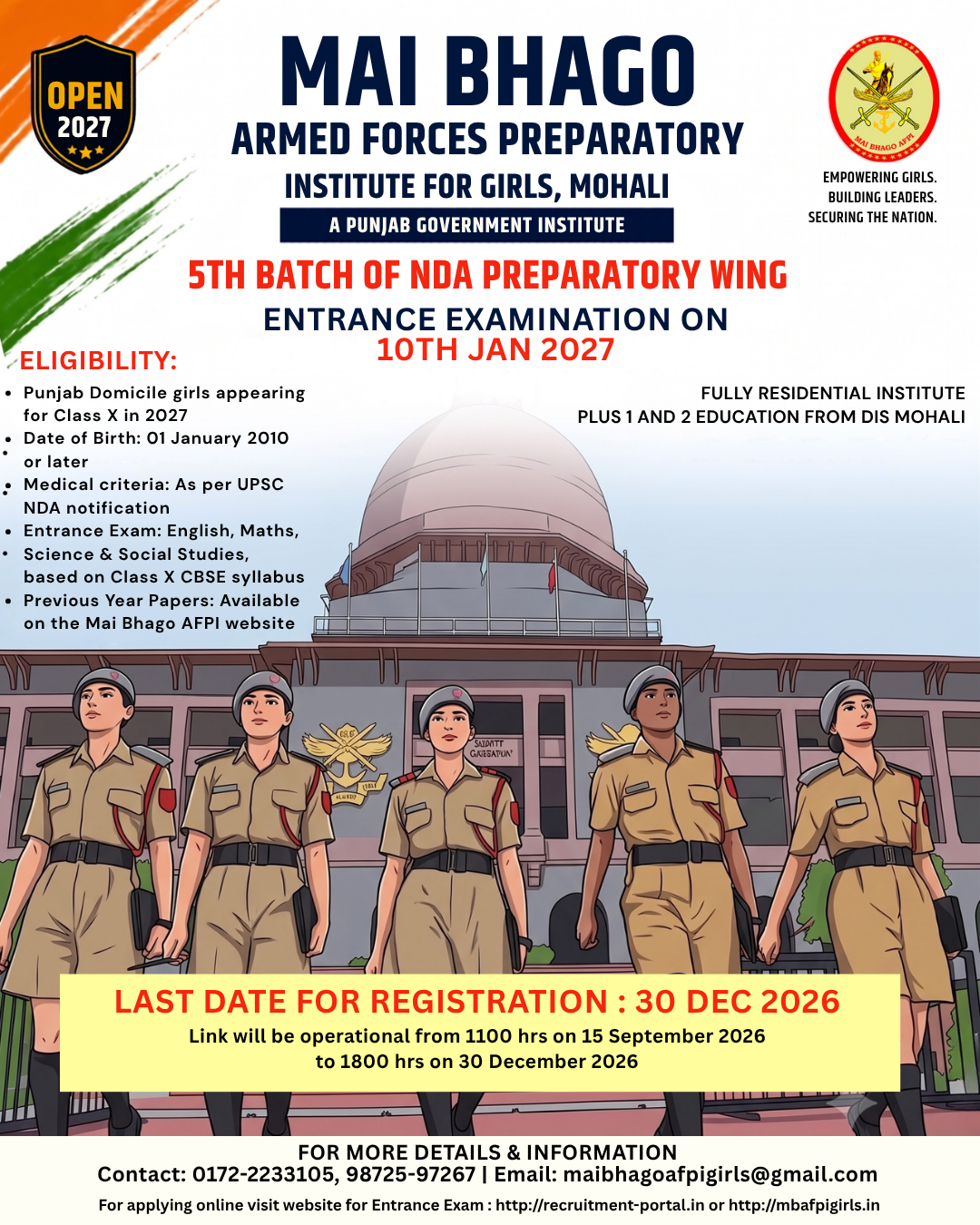
Mai Bhago AFPI, Sector 66, SAS Nagar (Mohali), is a Punjab Government residential institute where PIQ drafting, mock interviews with serving and retired officers, psychology test practice and GTO ground work are part of the regular training calendar, not an add-on. Working through real SSB personal interview questions with an assessor is built in.
Editorial note: SSB procedures are laid down by the Services Selection Boards and revised from time to time. Cross-check entry and exam details with joinindianarmy.nic.in and upsc.gov.in. This guide reflects the position as of September 2026.