
The AFSB PABT test is the one assessment in the entire Indian defence selection system that you are allowed to attempt exactly once in your life. Fail it, and no amount of preparation, no second attempt, no appeal and no alternative service will ever let you fly for the Indian Air Force, the Army, the Navy or the Coast Guard.
The AFSB PABT test is really two things bolted together: the standard Selection Board assessment, and the CPSS, formerly the PABT, administered only at the Air Force Selection Board. Most aspirants walk into AFSB assuming it is simply “SSB for the Air Force”. It is not. The structure is shared, but there is an additional test with permanent consequences bolted onto it, and almost nobody prepares for it because it looks like a computer game.

1. AFSB vs SSB: What Is Actually Different
The Services Selection Board (SSB) is the common five-day assessment used by the Army and Navy. The Air Force Selection Board runs the same core architecture, screening, psychological testing, group testing, personal interview and conference, assessing the same fifteen Officer Like Qualities.
Three things set the AFSB PABT test process apart. First, the CPSS or PABT flying aptitude test, administered only to candidates recommended for the Flying Branch, which does not exist at Army or Navy SSBs. Second, the one-attempt-in-a-lifetime rule attached to that test, which has no parallel anywhere else in Indian defence selection. Third, a stricter medical, particularly on vision, for Flying Branch candidates.
Everything else, the TAT, the WAT, the SRT, the group discussion, the individual obstacles and the conference, you will recognise from our five-day SSB breakdown. Read that first; this piece assumes you know the standard structure and focuses on what is unique to the Air Force.
2. Where AFSBs Are Located and How Long Testing Takes
Air Force Selection Boards operate at Dehradun, Mysuru, Gandhinagar, Varanasi and Guwahati. Your call letter allots your centre; you do not choose it, and requests to change are rarely entertained.
Testing runs approximately five to six days from reporting. Candidates screened out on Day 1 leave the same evening. Flying Branch candidates who are recommended stay an extra day for the AFSB PABT test. Travel is at government expense for candidates appearing for the first time in a particular entry, on production of the prescribed tickets, so keep every ticket.
3. Stage 1: The Screening Day
The AFSB PABT test opens with Stage 1, which runs on the first day and eliminates roughly half to two-thirds of the reporting strength. It has two parts.
The Officer Intelligence Rating (OIR) test is two papers of verbal and non-verbal reasoning, tightly timed. Speed matters as much as accuracy; most candidates who fail here ran out of time, not out of ability. The Picture Perception and Description Test (PPDT) shows a hazy picture for around 30 seconds, then asks you to write a story and take part in a group discussion where the group must agree on a common story.
Your Stage 1 result combines both, and is announced the same day. Screened-out candidates get a form, their travel allowance and a train home. There is no appeal and no feedback. This is the single highest-attrition point in the entire process, and the least prepared-for.
4. Stage 2: Psychology, GTO and Interview
Stage 2 is the longest part of the AFSB PABT test. Candidates who clear Stage 1 stay for four more days of assessment by three independent assessors who do not discuss you with each other until the final conference.
The Psychologist administers the Thematic Apperception Test, Word Association Test, Situation Reaction Test and Self Description. These are written, timed and volume-heavy: 60 words, 60 situations, minimal thinking time. Under that pressure you write what you actually are, not what you rehearsed.
The Ground Testing Officer runs the outdoor series over two days: Group Discussion, Group Planning Exercise, Progressive Group Task, Half Group Task, Individual Obstacles, Command Task, Snake Race, Individual Lecturette and the Final Group Task. The Interviewing Officer conducts the personal interview, built almost entirely from the Personal Information Questionnaire you filled on Day 1.
5. CPSS and PABT: The Once-in-a-Lifetime Test
Here is the part that deserves your full attention. The Pilot Aptitude Battery Test (PABT) was the Air Force’s flying aptitude assessment for decades. It has been progressively replaced by the Computerised Pilot Selection System (CPSS), conceived when Dr APJ Abdul Kalam was Scientific Adviser to the Prime Minister and developed by DRDO laboratories including the Defence Institute of Psychological Research and the Aeronautical Development Establishment.
The rule, stated plainly by the Indian Air Force itself: CPSS is administered only to recommended Flying Branch candidates, it is a once-in-a-lifetime test, and candidates who have failed the CPSS or PABT in an earlier attempt, or a Flight Cadet suspended from flying training, are not eligible.
Three consequences follow. There is no second attempt, ever, not next year and not with a different entry. The bar extends across services: a failure closes flying in the Indian Air Force, Army Aviation, the Navy and the Coast Guard, though you may still be commissioned as an officer. And you cannot decline it selectively, so applying for the Flying Branch “just to see” spends an attempt you can never recover. The honest advice to a Class 12 girl who wants to fly is not “apply everywhere and see”, it is: get medically and physically ready, prepare for the aptitude test, then apply once, properly.
6. What CPSS Actually Measures
The CPSS component of the AFSB PABT test assesses cognitive and psychomotor ability by making you perform several tasks at once, because that is what flying is.
It has a computer-based component, beginning with instrument comprehension: you are shown aircraft instrument panels, chiefly the artificial horizon and compass, and asked to identify the aircraft’s attitude and heading. Two silhouettes, one correct answer, very little time. It also has a machine-test component, in which you operate a control column and rudder pedals to keep a target under control while responding to secondary tasks, lights, tones and reaction sequences. The system deliberately overloads you, measuring whether your hands, feet, eyes and attention can be divided without collapsing.
CPSS has more written parts and machine tests than the older PABT, and briefing is by video rather than an officer, but the underlying skills are the same. What it is not measuring: intelligence, knowledge, general aptitude, or how badly you want it. Psychomotor coordination is a real and largely stable trait. Some very capable candidates do not have it, and that is worth knowing before you spend an attempt.
7. How to Prepare for a Test You Cannot Retake
You cannot fake psychomotor ability. You can remove every avoidable disadvantage before the AFSB PABT test.
- Learn to read instruments cold. Instrument comprehension is genuinely learnable. Work through artificial horizon and compass problems until reading aircraft attitude is automatic. This is the most improvable component and the one most candidates neglect.
- Get comfortable with dual-task load. Anything that trains divided attention with hands and feet helps: simulator practice, driving, games needing simultaneous stick and pedal input. It is what the test samples.
- Use your practice runs deliberately. The machine tests give a few familiarisation runs. Use the first to understand control sensitivity, not to score. Candidates who go in cold spend their real attempt learning how hard to push the stick.
- Do not go in exhausted. CPSS falls at the end of an intense five-day assessment. Sleep, hydration and food on the preceding days are part of your preparation.
- Be honest about eligibility. If your vision is not 6/6 uncorrected or your height is under 162.5 cm, the Flying Branch is closed anyway. Check our AFCAT eligibility guide for women before anything else.
8. Conference and Results
On the final day, the Psychologist, GTO and Interviewing Officer sit together in conference. Each candidate appears briefly, and the board then decides on recommendation.
Results are announced the same day. Recommended candidates proceed to the medical board, usually at an Air Force Central Medical Establishment or a designated military hospital. Recommendation is not selection: the medical board and the All India Merit List still stand between you and joining instructions. If the cockpit is the goal, our guide on how to become a woman fighter pilot sets out every route into the Flying Branch.
Frequently Asked Questions
The assessment standard is comparable, with the same OLQs and the same structure. The AFSB PABT test adds the CPSS for Flying Branch candidates, an additional and permanent filter that does not exist elsewhere.
No. The AFSB PABT test is explicitly a once-in-a-lifetime test. A failure permanently bars you from flying duties in the Indian Air Force, Army Aviation, Navy and Coast Guard.
Yes. Failing the AFSB PABT test closes flying, not an officer career. You remain eligible for Ground Duty branches in the Air Force and for officer entries in the Army and Navy.
Yes. The test, the standard and the one-attempt rule of the AFSB PABT test are identical for women and men.
No. CPSS is administered only to candidates recommended at the end of Stage 2 for the Flying Branch. If you never reached that point, your attempt is intact.
No. Clearing CPSS makes you eligible for the Flying Branch. Streaming into fighters, transport or helicopters is decided later, during training at the Air Force Academy, on the basis of performance and service requirement.
Preparing for AFSB in Punjab?
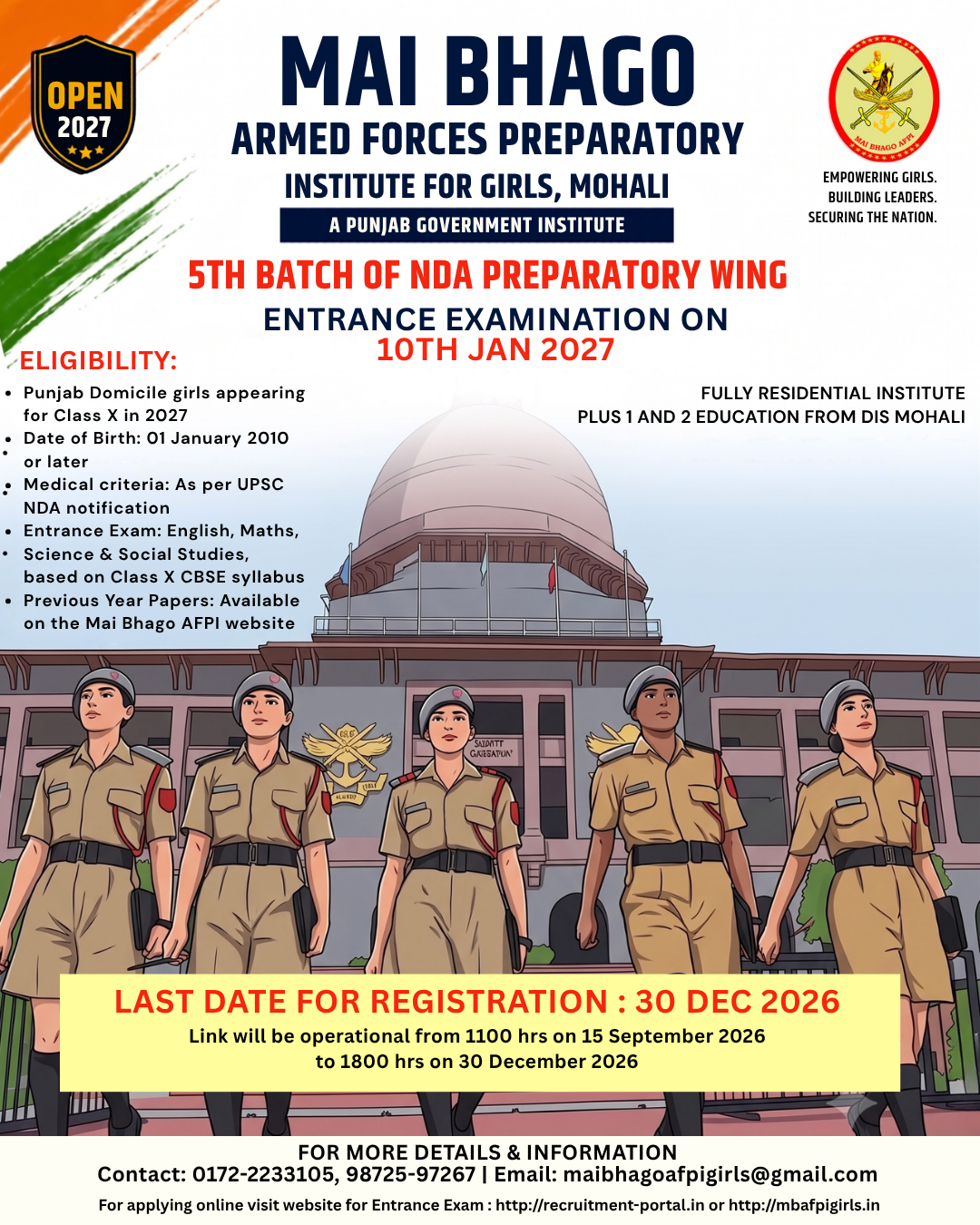
Mai Bhago AFPI, Sector 66, Mohali, is a Punjab Government residential institute that prepares girls from across the state for the SSB and the AFSB PABT test, with serving and retired officers, structured GTO ground practice, psychology test drills and mock interviews built into the training calendar rather than sold as an add-on.
Editorial note: AFSB centres, testing schedules and CPSS administration are laid down by the Indian Air Force and revised from time to time. Verify current details on careerairforce.gov.in, on indianairforce.nic.in and on your call letter. This guide reflects the position as of September 2026.